HVAC, Building Performance: Cooling Tower Maintenance & Goodway’s Cooling Tower Vacuum
We’ve talked about cooling tower maintenance quite a bit on the Goodway blog. And now that it’s spring and we’re starting to think about air conditioning maintenance, the subject is on our minds once again.
If you look back at past posts, you’ll see that the top two reasons for cooling tower maintenance resonate through them all: energy efficiency/system performance and health.
Often the importance of cooling tower efficiency is a bit overlooked because the focus is on chiller efficiency.
“Chillers use about five times the energy of the cooling tower. Consequently, more attention is paid to the chiller than the cooling tower in most facilities,” Steve Spielmann, Goodway’s Customer Service/Technical Manager, explains in this post about cooling tower maintenance.
Your Next HVAC Purchase?
Click to activate a 10% coupon or insert the coupon code 10PERCENT upon checkout.
Read full blog post »
Your HVAC Spring Cleaning Checklists Redux
Spring is just around the corner, and that means summer can’t be too far behind.
As winter makes it exit – not soon enough for some of us – it’s time to turn your attention to keeping your HVAC system humming right along through the hot summer months.
Last year we offered you three comprehensive checklists of tasks and tips to ensure the cooling system in your facility is operating at 100%.
Your Next HVAC Purchase?
Click to activate a 10% coupon or insert the coupon code 10PERCENT upon checkout.
Read full blog post »
AHR EXPO 2013 SHOW PREVIEW

Next week the who’s who of the HVAC world will be coming together in Dallas, TX for the annual AHR Expo trade show. And of course, Goodway will be there. In fact, this year could be the best show yet.
Stop by our booth (#2367) and see our brand new award winning products that will complete your maintenance tasks faster and easier than before, like our new CoilPro CC-400HF HiFlow coil cleaner that’s designed specifically for safely cleaning dirty, grimy coils up to 8 inches thick. Learn more.
CC-400HF Features:
- Hi-Flow pump system – Delivers 400 psi at 3.0 GPM
- Specialized attachments – Designed to clean coils from any angle, including back flushing in tight spot.
- Integrated Cleaner Injection – automatically pulls in coil cleaner when you need it.
- Portable Design – easily transported to rooftops and remote locations
We will also be showcase the latest in our tube cleaning line the RAM-PRO series. This is a workhorse with a soft side. Rugged, sturdy and built to last, but with the finesse to clean even the mos sensitive tubes. Learn more here.
Plus, we’re hosting a very special VIP party filled with good times, gifts and a special celebrity athlete guest that will be signing autographs, taking pictures and talking sports. We will also have
- Cocktail hour
- Goodway bag filled with great give aways
- Opportunity to win an iPad mini
- and much more….
But space is limited to this event so call a Goodway rep at 1-800-333-7467 to find out more about getting your VIP invite.
Your Next HVAC Purchase?
Click to activate a 10% coupon or insert the coupon code 10PERCENT upon checkout.
Post-Hurricane Sandy Series: Clearing Flood Waters
This week we continue our Post-Hurricane Sandy Series with what you need to know about clearing flood waters.
Our next posts in the series address mold and mildew management, cooling towers and FEMA (Federal Emergency Management Agency) assistance.
Safety is probably the most crucial factor to consider in dealing with flooding. Flood water can contain a host of infectious organisms including E. coli, shigella, salmonella, hepatitis A virus, as well as typhoid, tetanus or paratyphoid agents, according to the Occupational Safety & Health Administration (OSHA).
But it doesn’t stop there because flood waters may also become contaminated by industrial chemicals from flooded hazardous waste sites.
Your Next HVAC Purchase?
Click to activate a 10% coupon or insert the coupon code 10PERCENT upon checkout.
Read full blog post »
Risk Management When Using Ammonia as a Refrigerant
Ammonia is looking like one of the more plausible solutions for replacing refrigerants that damage the environment including HFCs (hydrofluorocarbons), as we note in our previous post, Ammonia As A Refrigerant: Pros and Cons – Follow Up.
Our 2009 post, Ammonia As a Refrigerant: Pros and Cons, has become one of our most popular blogs, possibly because of the buzz that’s been generated around using ammonia to replace common refrigerants.
While ammonia has been used less in the past because of health hazards as well as its smell, the newer technologies are making ammonia use safer in chiller tubes, air conditioner coils and cooling towers.
Your Next HVAC Purchase?
Click to activate a 10% coupon or insert the coupon code 10PERCENT upon checkout.
Read full blog post »
A Greener Choice: Ammonia as a Refrigerant
Supermarkets are high energy users, with more than half of their energy usage attributed to refrigeration, according to an article in Environmental Protection.
The online publication points to a paper from the Oak Ridge National Laboratory that puts the average supermarket energy usage at 1 million to 1.5 million kWh per year. Compare that to the 11,040 kWh an average home uses per year. High energy usage, particularly with some of the older technologies, leads to more wear and tear on our ozone layer, according to the article.
The EPA’s GreenChill partnership program works with supermarkets and other food retailers to reduce refrigerant emissions by making operational changes, investing in new systems and focusing more intensely on leak prevention. Retailers showing the most improvement in energy efficiency initiatives are recognized yearly by the EPA. The most recent awards ceremony was held in early September.
Newer stores have the upper hand in emissions reductions as they can use newer refrigeration systems. Many of these newer stores offer technologies not available when the GreenChill program originally started.
Ammonia is part of a group of natural refrigerants, similar to propane, carbon dioxide and other gases, that is showing more use throughout the industry in, according to Supermarket News. These gases have little impact on global warming and don’t harm the ozone layer.
While ammonia has been used less in the past because of health hazards as well as its smell, the newer technologies are making ammonia use safer in chiller tubes, air conditioner coils and cooling towers. Ammonia is becoming a potential replacement for other refrigerants, such as R-22, which are known to harm the ozone and affect global warming harshly.
Keilly Witman, a representative for the EPA’s GreenChill program, spoke last spring at the Food Marketing Institute Expo about ammonia and other natural refrigerants dominating the food retail industry, according to Air Conditioning, Heating and Refrigeration News.
“In the U.S. supermarket industry, misconceptions of ammonia (R-717) and the codes that govern it, coupled with a lack of knowledge pertaining to the systems, serve as major hurdles that will need to be cleared before ammonia can be accepted as a viable alternative to traditional halocarbon refrigerants,” says Caleb Nelson of CTA Architects speaking at the International Institute of Ammonia Refrigeration’s annual conference in 2012.
In the same speech Nelson explains that ammonia has been used safely and efficiently for years in other industries around the world. The initial cost and training can be substantial, but they’re only temporary. And the issues with ammonia use are no different that the issues faced in using other natural refrigerant technologies.
Next Steps:
- Read Ammonia As a Refrigerant: Pros and Cons, one of our most popular posts.
- Read Ammonia As a Refrigerant: Pros and Cons Follow Up, a follow-up to the popular post.
- Subscribe to our blog to receive the full blog series via email and stay informed about the latest HVAC news and insight.
- Stay up to date on facility maintenance tools such as chiller tube cleaners, boiler tube cleaners, hose/pipe cleaners, descaler systems, industrial vacuums, commercial pressure washers, and drain cleaners.
Your Next HVAC Purchase?
Click to activate a 10% coupon or insert the coupon code 10PERCENT upon checkout.
Power Plant Descaling: More Important Than You Think
Sometimes when we in the industry think of descaling power plants, we mainly think of the large condenser boxes that create steam and run turbines. And while that is a huge part of the operation, there are dozens of other applications where water is used within a power plant.
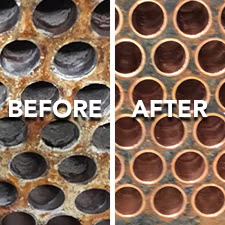
The most common scale ingredient is CaCO3, or calcium carbonate, the main ingredient in hard water. Herein lies the problem: if thousands of gallons of water are flowing through boilers, heat exchangers, condensers, cooling towers and other parts of a power plant, scale is likely to build up.
How Stuff Works shows us how a nuclear power plant works. The Centre for Energy shows us how a thermal power plant works. And the U.S. Geological Survey shows us the inner workings of a hydroelectric power plant. Although the plants vary in operation, function and components, what the illustrations show is that a power plant contains numerous large applications with water circulating through them, requiring descaling.
Your Next HVAC Purchase?
Click to activate a 10% coupon or insert the coupon code 10PERCENT upon checkout.
Read full blog post »
The Nitty Gritty Behind Cleaning Air Conditioner Coils
This week’s post ends our series on “Spring cleaning” your facility’s cooling system. You can download our three printable HVAC cleaning checklists for reference:
Checklist 1: How to Clean Chiller Tubes
Checklist 2: How To Clean Air Conditioner Coils
Checklist 3: How to Clean Cooling Towers
(Note: You must provide your email address to get access to each checklist.)
This last post in our HVAC “Spring Cleaning” blog series addresses how to properly clean your cooling system’s air conditioner coils.
Your Next HVAC Purchase?
Click to activate a 10% coupon or insert the coupon code 10PERCENT upon checkout.
Read full blog post »
How to Effectively Clean Your Chiller and Cooling Tower
This week’s post continues our HVAC “Spring Cleaning” series on giving your facility’s cooling system some much needed attention before warmer weather arrives. Below are our three printable HVAC cleaning checklists to get you started:
Checklist 1: How to Clean Chiller Tubes
Checklist 2: How To Clean Air Conditioner Coils
Checklist 3: How to Clean Cooling Towers
(Note: You must provide your email address to get access to each checklist.)
The second post in our HVAC “Spring Cleaning” blog series explains how to clean chiller tubes and cooling towers. The last post in the series will explain how to properly clean your cooling system’s air conditioner coils.
Here’s more about this week’s topic – cleaning chiller tubes and cooling towers:
Your Next HVAC Purchase?
Click to activate a 10% coupon or insert the coupon code 10PERCENT upon checkout.
Read full blog post »
Starting Your HVAC “Spring Cleaning” Checklist is as Easy as 1-2-3
Now – before the summer heat arrives – is the time to give your facility’s cooling system attention. Fortunately, Goodway makes it easy for you to start today. Below are three printable HVAC cleaning checklists to get the ball rolling:
Checklist 1: How to Clean Chiller Tubes
Checklist 2: How To Clean Air Conditioner Coils
Checklist 3: How to Clean Cooling Towers
(Note: You must provide your email address to get access to each checklist.)
We are also writing a HVAC “Spring Cleaning” blog series to explain each checklist in more detail. This first post in the series is an HVAC cleaning overview. The remaining two posts in the series will explain how to properly clean your cooling system’s chiller tubes, air conditioner coils and cooling towers. In these future posts, we’ll discuss the importance of cleaning specific parts of your cooling system and specifically reference these checklists that address the procedures and what tools/products you’ll need to get the job done right.
For now, here’s the overview . . .
Your Next HVAC Purchase?
Click to activate a 10% coupon or insert the coupon code 10PERCENT upon checkout.
Read full blog post »